
News · Events · Conference — 13 October 2025
International Seminar "Music and Social Emergencies: Contemporary Transformations in Music and Society"
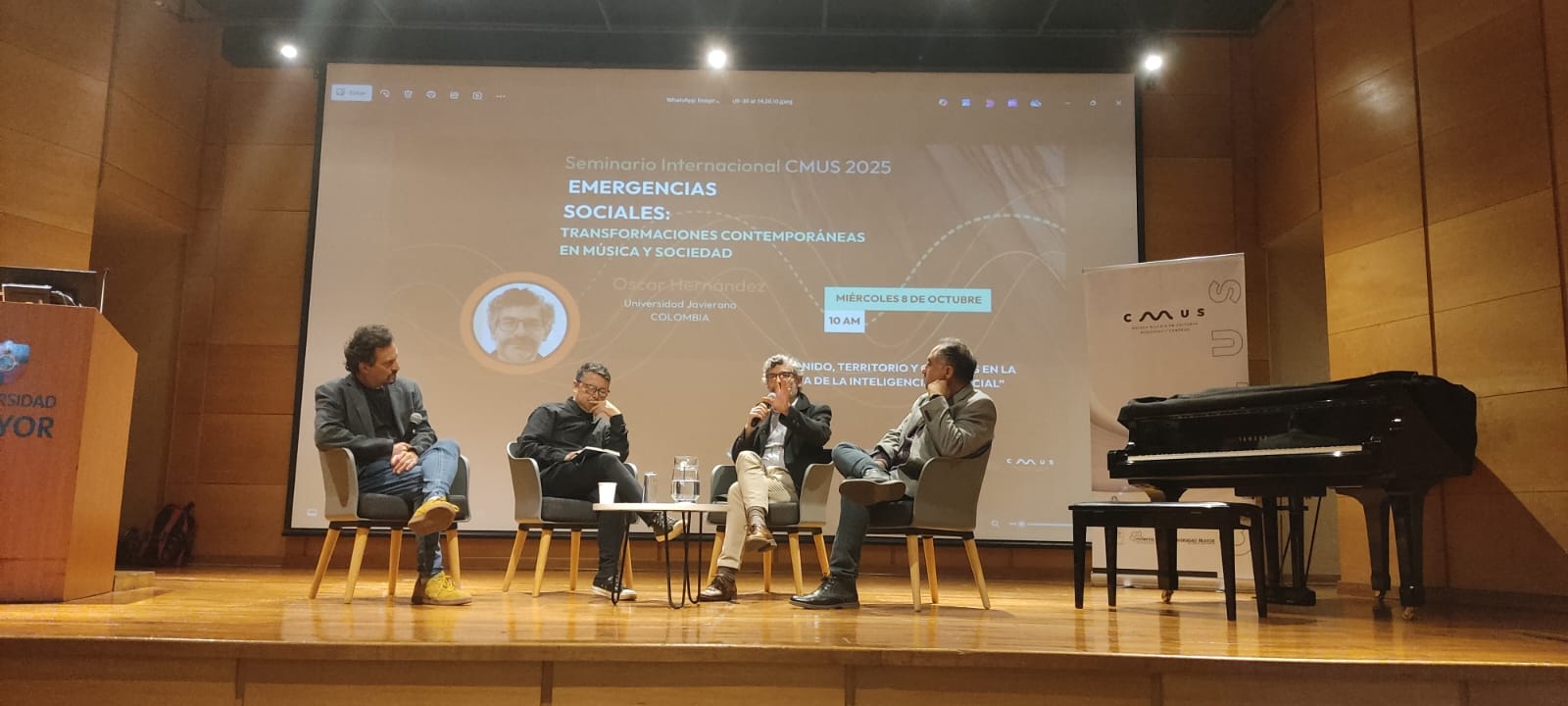
Organized by CMUS, the International Seminar Music and Social Emergencies: Contemporary Transformations in Music and Society was held on October 8, 9, and 10, and featured international guests including Oscar Hernández from Colombia, Jess Reia from the USA/Brazil, and Pablo Semán from Argentina.
This gathering brought together CMUS researchers who traveled from other cities across the country, creating an atmosphere of open and fruitful dialogue. On the first day, Oscar Hernández gave the lecture "Sound, Territory, and Commons in the Age of Artificial Intelligence," in which he discussed the latest advances in this technology within the cultural and musical world. He reflected: "Many people have said that Spotify's algorithms recommend something similar in order to keep listening time on the platform. That's why it's difficult to hear something radically different. There is a tendency to resist these algorithms, but they remain a minority. But the algorithm works, and that's why it earns millions."
This then led to a discussion panel alongside Christian Spencer (UM), Rodrigo Cádiz (PUC), and Arturo Cariceo (UCH). That same afternoon, CMUS members held a meeting in which they reviewed these three years of work at the Nucleus, with positive evaluations. The second day was led by Jess Reia, who gave the lecture "Governance of Urban Music: What Busking Can Teach Us about Data, Policy, and Our Cities," in which she addressed the central themes of her latest book, Urban Music Governance: What Busking Can Teach Us about Data, Policy and Our Cities (Urban Music Studies), focused on buskers (street performers) in different cities: Rio de Janeiro and Montreal. She said: "There are preconceptions about immigrant people that lead to the criminalization of poverty, since they may be seen as not being real artists. They are told very derogatory things and are considered to be doing informal work. It's an important phenomenon in Latin America, but invisible in terms of public policy." This was followed by a discussion panel with Marisol Facuse (UCH), Catalina Chamorro (UAHC), and Alma Calderón López (UCM), moderated by Laura Jordán (PUCV). That afternoon, CMUS's principal researcher, Daniel Party, together with the international guests, held a special workshop for the Nucleus's thesis students at Universidad Alberto Hurtado.
The third and final day featured a lecture by Pablo Semán, "100% White and from the Villa: Rebellious Conservatism, Free Market, and Popular Right-Wing Movements," in which he explored the music of discontent that has been forged since the 1990s and that today serves as the soundtrack of the Argentine president's campaign, government, and followers. "From (Javier) Milei's point of view, it is an unconventional use of a musical tradition that once had a different meaning. He operates and works with the free valences of this music to give it new meaning through performance, through the context in which it is set, through its interpretation, and through, obviously, the political program that will follow." Finally, there was a discussion session joined by Andrés Kalawski (PUC), Beatriz Medeiros (CMUS), Javier Rodríguez (PUC/CMUS, Chile), and Elisa Montecinos (CMUS), moderated by Carla Pinochet (UAH).